
.png)
Top 20 Bank Statement Fraud Patterns Every Underwriter Should Know

In today's digital lending landscape, fraudsters are becoming increasingly sophisticated. While advanced technologies have made loan processing faster, they've also created new opportunities for financial fraud. One of the most common targets is the bank statement—a key document used to assess an applicant's financial health, cash flow, and repayment capacity.
For banks, Non-Banking Financial Companies (NBFCs), and fintech lenders, identifying fraud patterns early is essential to reducing credit risk and preventing financial losses. While legacy tools rely on basic optical character recognition (OCR) or rules-based checks, modern lenders need explainable evidence intelligence that links document-level anomalies directly to underlying financial logic.
This guide explores the 20 most critical bank statement fraud patterns every underwriter should recognize—and how platforms like Hobbiate (powered by FinLens and BharosaAI) empower underwriters to spot these red flags with speed, accuracy, and auditability.
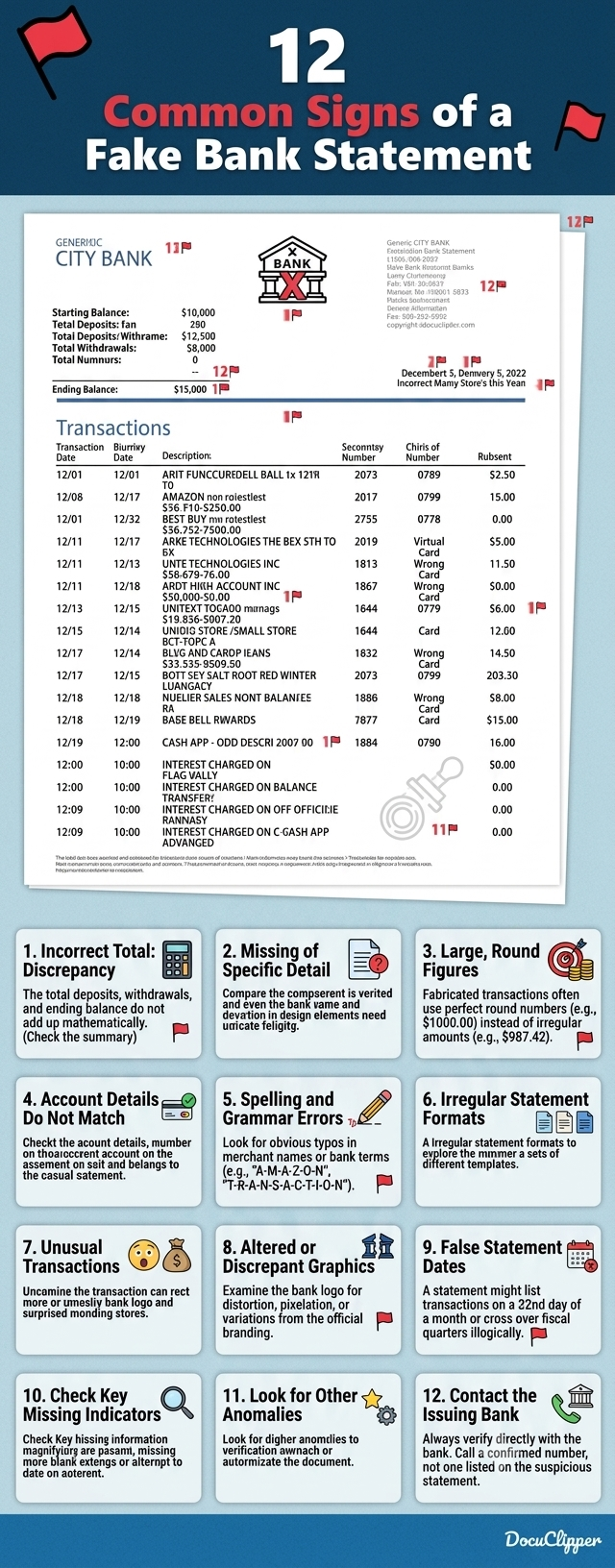
1. Mathematical & Running Balance Discrepancies
The most basic form of fraud occurs when line items are manually added, edited, or removed without adjusting the running balance.
Red Flag: Opening balance + Total Credits – Total Debits ≠ Closing balance.
Underwriter Check: Always re-verify the arithmetic line-by-line across multi-page statements.
2. Document Metadata Manipulation
PDF editing tools leave digital footprints within the file structure (such as modification timestamps, creator application names like Adobe Acrobat or PDF editors, or non-bank PDF generators).
Red Flag: PDF metadata indicates software like Photoshop or Nitro PDF was used post-generation.
Underwriter Check: Check the PDF metadata properties before evaluating the transaction content.
3. Font Misalignment & Formatting Inconsistencies
Authentic bank statements use uniform fonts, alignment, spacing, and character encodings generated by automated core banking systems.
Red Flag: Mixed font families, altered font weights, or slightly misaligned numerical columns.
Underwriter Check: Zoom in on numbers and dates; altered text often shifts by a few pixels compared to surrounding rows.
4. Modified Logos & Header Branding
Applicants attempting to alter statements often fail to replicate, bank header layouts, or official branch details.
Red Flag: Low-resolution logos, outdated bank branding, or incorrect bank branch addresses and IFSC/SWIFT codes.
Underwriter Check: Compare the statement header directly against a verified, known sample from the same institution.
5. Round-Number Transaction Inflation
Fraudulent statements often include fabricated large deposits designed to artificially inflate average monthly balance (AMB) or revenue figures.
Red Flag: Unexplained round-figure deposits (e.g., $50,000 or ₹5,000,000) right before the statement cut-off date.
Underwriter Check: Cross-reference round credits with corresponding business invoices or tax filings.
6. Cash Stacking / Temporary Liquidity Injection
Also known as "balance padding," borrowers temporarily borrow funds from family or short-term lenders to inflate account balances during the assessment window.
Red Flag: A sudden spike in deposits near the end of the statement period, followed immediately by rapid withdrawals post-application.
Underwriter Check: Look for "in-and-out" velocity patterns where high balances exist only briefly.
7. Circular Transactions & Round-Tripping
To simulate active revenue, related-party entities pass funds back and forth in continuous loops.
Red Flag: Reciprocal payment loops between Entity A, Entity B, and Entity C with similar transaction amounts and frequency.
Underwriter Check: Map out counterparty identities to identify related-party circulation rather than genuine customer payments.
8. Missing or Altered Transaction IDs / Reference Numbers
Core banking systems assign unique sequence identifiers, UTR numbers, or transaction hashes to every line item.
Red Flag: Missing transaction IDs, duplicate reference numbers across different entries, or non-standard reference formats.
Underwriter Check: Verify that reference numbers follow the standard syntax for the specific bank.
9. Date Discrepancies & Non-Sequential Timeline
Manual edits frequently introduce chronological errors in transaction logs.
Red Flag: Transactions listed out of chronological order or entries occurring on non-banking days (e.g., public holidays where clearing doesn't run).
Underwriter Check: Verify transaction sequences alongside value dates vs. posting dates.
10. Missing Pages & Selective Reporting
Applicants may omit specific pages containing high negative balances, penalty charges, or bounced checks.
Red Flag: Page numbering skips (e.g., Page 2 of 5 followed by Page 4 of 5) or closing balances on Page 2 don't match opening balances on Page 3.
Underwriter Check: Always verify continuity across every page break in the document set.

11. Fake Salary / Revenue Deposits
Fraudsters disguise transfer payments from friends or personal accounts as corporate payroll or commercial revenue.
Red Flag: Deposits labeled "Salary" or "Client Payment" originating from individual UPI IDs, personal accounts, or unverified P2P handles.
Underwriter Check: Cross-verify payment descriptions with actual sender entity names.
12. Cheque Bounce & ECS Return Erasure
Borrowers facing credit distress often edit out bounced check fees, NSF (Non-Sufficient Funds) charges, or failed NACH debit attempts.
Red Flag: A statement showing zero return charges despite volatile low balance swings near zero.
Underwriter Check: Calculate minimum daily balances to check if penalty thresholds should have triggered fees.
13. Revenue-to-Tax Mismatch
Forged statements often display top-line credit totals that completely contradict official tax filings (GST, VAT, or Income Tax Returns).
Red Flag: Bank statement credit totals significantly exceed turnover declared in government tax portals.
Underwriter Check: Perform automated revenue reconstruction across bank statements and tax filings.
14. Duplicate Copy Submission across Multiple Entities
SME applicants operating multiple companies sometimes submit identical or slightly modified statement copies for separate loan applications.
Red Flag: Matching transaction amounts, dates, and balances submitted under different business registration numbers.
Underwriter Check: Use enterprise cross-entity duplicate detection across historical loan files.
15. Hidden Loan Obligations & Shadow Liabilities
Borrowers omit debt service obligations by renaming transaction narratives associated with micro-lenders or high-interest NBFCs.
Red Flag: Regular monthly outbound debit amounts matching fixed installment schedules, but disguised as vendor payments.
Underwriter Check: Analyze recurring debit patterns to isolate undisclosed debt obligations.
16. Pixelation & Artifacts Around Text Elements
When images are edited using raster graphics tools, compression artifacts accumulate around altered numbers.
Red Flag: Fuzzy or pixelated background noise specifically around amounts, dates, or balances while the rest of the page remains crisp.
Underwriter Check: Inspect underlying image layers or run error level analysis (ELA).
17. Inconsistent Currency Formatting & Punctuation
Different banking software uses distinct decimal and comma separators (e.g., $1,000.00 vs ₹1,00,000.00).
Red Flag: Mixing international and local currency notation formats within the same document.
Underwriter Check: Ensure formatting matches the home country and standard system configuration of the originating bank.
18. Ghost Counterparties & Shell Company Transfers
High transaction volume created through transfers to shell companies created solely to boost bank turnover.
Red Flag: Outward transfers to newly registered entities with zero digital footprint or matching registered addresses.
Underwriter Check: Validate counterparty credibility against external corporate registers and business data.
19. Excessive Cash Deposits in Digital Businesses
Businesses claiming to operate online or B2B tech services showing disproportionate cash deposit volumes.
Red Flag: B2B software or professional service providers showing heavy over-the-counter cash deposits.
Underwriter Check: Evaluate cash flow proportions against the applicant's stated business model.
20. Altered Digital Signatures & Encryption Certificates
Original bank e-statements typically carry cryptographically signed digital certificates from the issuing bank.
Red Flag: Missing security certificates, invalidated digital signatures, or "Document Modified" warnings upon opening in digital readers.
Underwriter Check: Check signature validity and root authority certificates directly within the PDF viewer.
How Hobbiate Solves Bank Statement Fraud Detection
Detecting all 20 fraud patterns manually is time-consuming, prone to human error, and difficult to scale across high-volume loan operations. While general OCR tools and basic rule engines can flag surface-level errors, they fall short when dealing with complex financial manipulation, related-party loops, or revenue mismatches.
This is where Hobbiate transforms underwriting operations.
Hobbiate helps banks, NBFCs, and fintech lenders operationalize explainable underwriting using evidence intelligence, deterministic analysis, and governed AI workflows.

1. FinLens: Financial Evidence Intelligence for Underwriters
Hobbiate’s flagship product, FinLens, turns messy borrower financial data into structured, explainable underwriting evidence.
Multi-Account Intelligence: Extracts and reconciles bank statements across diverse formats and multiple bank accounts seamlessly.
Deterministic Fraud & Anomaly Detection: Combines mathematical verification with intelligent pattern matching to spot running balance errors, metadata tampering, circular transactions, and cash stacking.
Revenue Reconstruction: Rebuilds actual business cash flow and flags hidden revenue mismatches before loan sanctioning.
Explainable Signals: Instead of black-box AI scores, FinLens provides traceable, audit-ready evidence so underwriters can review exact lines and reasonings behind every flag.
2. BharosaAI: Governed & Auditable Workflows
Powered by a LangGraph orchestration engine, BharosaAI allows credit teams to define and automate enterprise-grade underwriting rules.
Human-in-the-Loop Review: Automates routine verification while escalating suspicious statements to human underwriters with pre-packaged evidence.
Deterministic Execution: Ensures every credit rule executes reliably without unexpected AI hallucinations.
Audit-Ready Compliance: Preserves complete decision traceability for internal risk teams and regulatory audits.
Comparing Underwriting Solutions
While general market tools (such as Perfios, FinBox, or nCino) provide valuable digitization and process automation, Hobbiate focuses specifically on explainable, evidence-backed intelligence and governed AI execution—ensuring lenders don't just process statements faster, but make safer, fully auditable lending decisions.
Conclusion
As fraudsters adopt generative AI and sophisticated editing tools, manual statement reviews are no longer enough to protect credit portfolios. By understanding these 20 bank statement fraud patterns and deploying evidence-backed solutions like Hobbiate (FinLens & BharosaAI), lenders can automate anomaly detection, accelerate loan approvals, and safeguard against credit risk.
Explore how Hobbiate can upgrade your credit intelligence workflows at www.hobbiate.com.

Comments